Upcoming Events
Jao’s heart will go on -- Lecture Series in Honour of Professor Jao Tsung-i

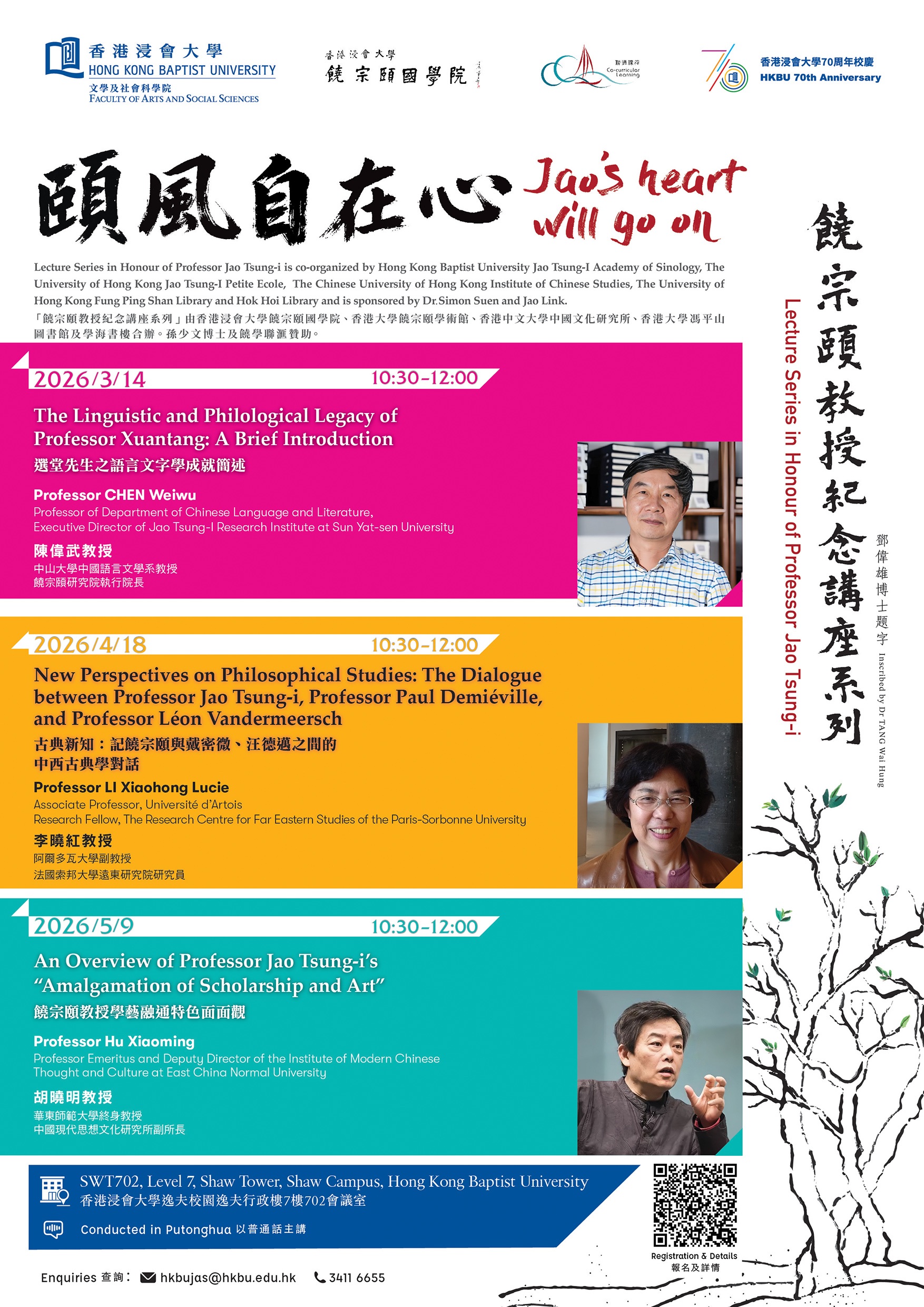
To commemorate the 110th birthday of the renowned Chinese studies master Professor Jao Tsung-i (1917-2018), Jao Tsung-I Academy of Sinology will co-organize a Lecture Series in Honour of Professor Jao Tsung-i with The University of Hong Kong Jao Tsung-I Petite Ecole, The Chinese University of Hong Kong Institute of Chinese Studies, The University of Hong Kong Fung Ping Shan Library and Hok Hoi Library in 2026. Supported by Dr Simon Suen and Jao Link, this lecture series will bring together a group of distinguished scholars and specialists well versed in Professor Jao Tsung-i’s life and academic work. The series aims to offer a comprehensive review of Professor Jao’s pioneering contributions to Chinese studies, Sinology, and the related arts, examining both the breadth of his scholarship and its lasting relevance. Through presentations and dialogues, the lectures will seek to engage the public with the depth and significance of Professor Jao’s intellectual legacy, while contributing to the continued documentation and dissemination of his research.
As Hong Kong Baptist University celebrates its 70th anniversary, the inaugural three lectures will be hosted by the Jao Tsung-I Academy of Sinology at HKBU and convened at Room 702, 7/F, Shaw Tower, Shaw Campus.
In honour of the enduring legacy of Professor Jao Tsung-i, you are cordially invited to join this distinguished lecture series.
2026/3/14 | 10:30–12:00
The Linguistic and Philological Legacy of Professor Xuantang: A Brief Introduction
Professor CHEN Weiwu
Professor of Department of Chinese Language and Literature, Executive Director of Jao Tsung-I Research Institute at Sun Yat-sen University
Language: Putonghua
Abstract: Professor Jao Tsung-i (1917–2018) was a renowned contemporary historian, classicist, archaeologist, paleographer, literary scholar, and painter-calligrapher. His academic research was extensive and comprehensive, spanning many fields within the humanities. Scholars generally categorize his works into eight major areas: oracle bone studies, history, archaeology, studies of the Songs of Chu (Chu ci), Dunhuang studies, ci poetry, bibliography, and painting and calligraphy. He made significant contributions to each of these fields and was acclaimed in academia as one who “mastered six scholarly disciplines and possessed nine talents,” and was praised for his “profound knowledge of ancient and modern times, seamlessly integrating Chinese and Western traditions.”
Professor Jao was deeply rooted in Chinese traditional culture while also well-versed in Western academic methodologies. He applied interdisciplinary knowledge to address complex issues in linguistics and paleography, while also using these disciplines as tools to expand other academic fields. This integrative approach closely linked the study of language and scripts with the research of ancient Chinese and foreign social and cultural history, resulting in numerous original and groundbreaking achievements.
This presentation, though modest, attempts to select and briefly elaborate on several aspects to provide an overview of Professor Jao’s contributions to linguistic and paleographic studies.
Lecture Review: Inaugural Jao Tsung-I memorial lecture illuminates the transdisciplinary legacy of Chinese studies master
2026/4/18 | 10:30–12:00
New Perspectives on Philosophical Studies: The Dialogue between Professor Jao Tsung-i, Professor Paul Demiéville, and Professor Léon Vandermeersch
Professor LI Xiaohong Lucie
Associate Professor at the Université d’Artois;
Research Fellow of the Research Centre for Far Eastern Studies of the Paris-Sorbonne University
Language: Putonghua
Abstract: Professor Jao Tsung-i held a deep affection for the Petites Écoles of the Abbey of Port-Royal des Champs in France. His student, Professor Léon Vandermeersch, accompanied him there on two occasions (in 1993 and again in 2017, when I had the privilege of joining them), to explore French classical scholarship. To commemorate this experience, Jao Tsung-i composed a renowned essay entitled “Petite École de Port-Royal des Champs”, in which he elaborated on the concepts of French classical philology embodied by the Petites Écoles. He even went so far as to name his own research institute the “Petite École.”
The Petites Écoles embodied the French tradition of classical philology — the interpretation of words, grammar, rhetoric, and logic, as well as the annotation and improvement of Biblical translations. After Paul Demiéville met Jao Tsung-i in 1954, he recognized the need to train European specialists in oracle bone inscriptions and recommended Vandermeersch to study Chinese classical learning under Jao in Hong Kong. Vandermeersch thus became the first Western scholar to introduce oracle bone studies to France.Although the definitions of 'classical studies' differ between Europe and China, both traditions share the mission of elucidating the essence of their cultures and promoting intercultural dialogue.
This lecture will retrace the history of the Petites Écoles, highlighting the reformist ideals of the Jansenist movement, which profoundly shaped French intellectual and cultural life in the 17th century. It will also analyze the ways in which the educational system of the Petites Écoles fostered a philological spirit rooted in the texts and culture of ancient Greece and Rome. Finally, it will show how Jao Tsung-i, Paul Demiéville, and Léon Vandermeersch — three major figures in Sino-French scholarship — built bridges between traditions, fostering dialogue, mutual understanding, reciprocal enrichment, and the development of academic life both in Europe and in mainland China as well as in Hong Kong.
2026/5/9 | 10:30–12:00
An Overview of Professor Jao Tsung-i’s “Amalgamation of Scholarship and Art”
Professor HU Xiaoming
Professor Emeritus and Deputy Director of the Institute of Modern Chinese Thought and Culture at East China Normal University
Language: Putonghua
Abstract: A distinctive feature of Professor Jao Tsung-i’s academic achievements is the seamless integration of scholarship and art. This lecture is divided into two approaches: one is entering art through scholarship, treating art as a form of learning; the other is entering scholarship through art, transforming learning into art. The former includes examples such as using the philosophy of the I Ching, Zhuangzi, and Chan Buddhism to reflect on painting, applying ancient paleography to calligraphy, incorporating archaeology into the study of calligraphy, and integrating academic archaeological travels into painting. The latter includes, for instance, conducting scholarship with the innocent, playful, and non-utilitarian spirit of an artist; using an artist’s imagination and empathy to assist textual research and verification; applying an artist’s curiosity to enhance scholarly inquiry; and undertaking major academic endeavors with the grand cosmic passion of an artist.
Drawing upon over forty hours of interviews with Professor Jao, Prof. Hu presents two key case studies for analysis: the poetry and painting “Spring in Jiangnan” and its significance, as well as an appreciation of Selected Purity: The Art of Jao Tsung-i. In an era marked by a divide between scholarship and art, revisiting this distinctive characteristic of Professor Jao is expected to deepen understanding of his academic work, contribute to a richer appreciation of China’s outstanding scholarly traditions, and inspire young scholars to internalize and embody these values in their own practice.