Upcoming Events
Professor KANG Youn Ok: The Influence of Chinese Characters on the Record-Keeping Culture of Confucian Thought of the Joseon Period (2025/10/30)

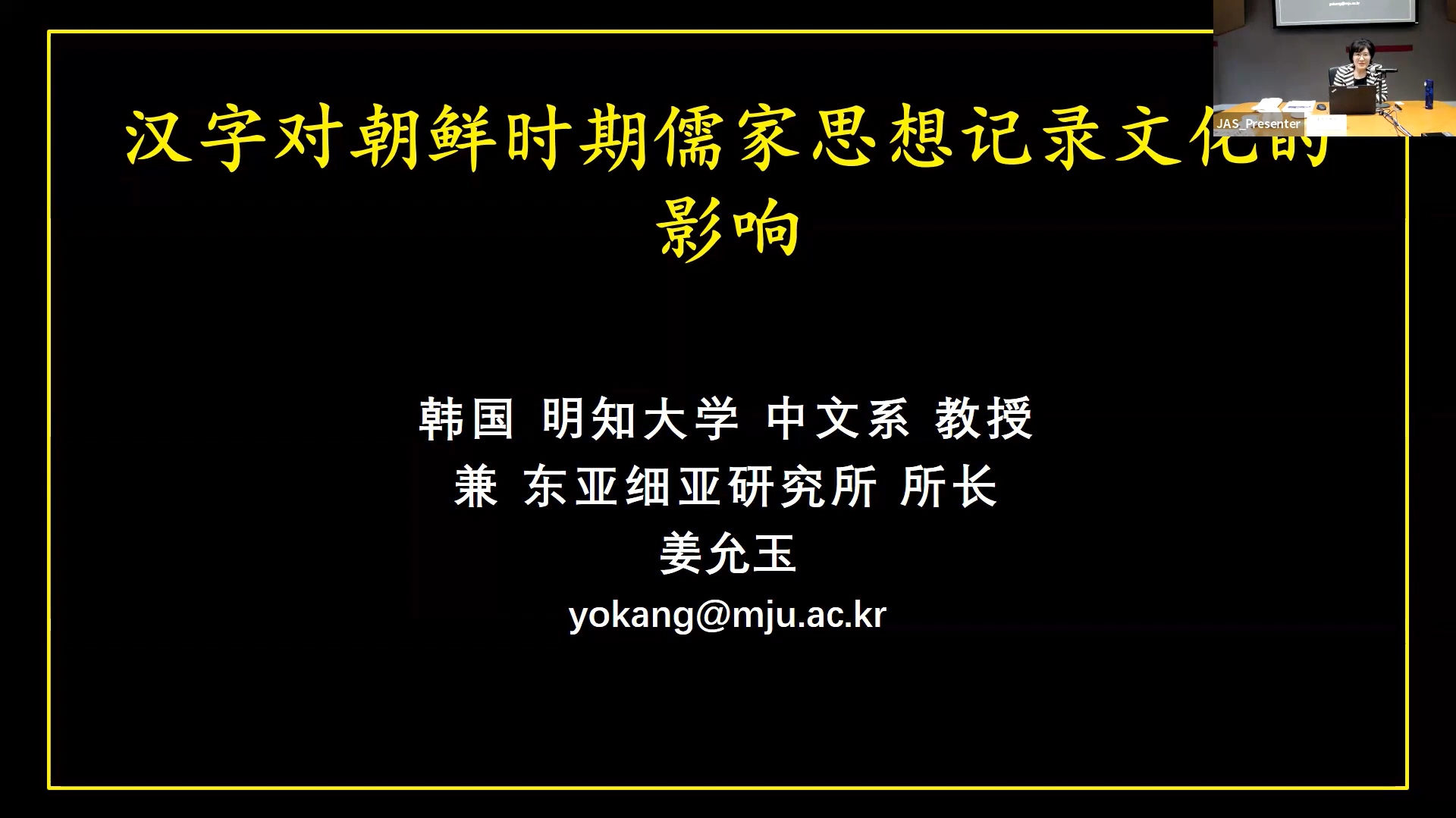
The fourth lecture in the series “Encounters in the Old World, East and West: From a Transdisciplinary Perspective” was held online via ZOOM on October 30. The event featured Professor KANG Youn Ok, Department of Chinese Language and Literature, Director of the Institute of East Asian Studies, Myongji University, who delivered a talk titled “The Influence of Chinese Characters on the Record-Keeping Culture of Confucian Thought of the Joseon Period.” The session was presided over by Dr. Shen Sicong, Post-Doctoral Research Fellow at the Jao Tsung-I Academy of Sinology, Hong Kong Baptist University.
Professor Kang first explained the process by which Chinese characters were introduced into the Korean peninsula, pointing out that bamboo slips unearthed in Pyongyang in the 1990s bear a strong resemblance to Han dynasty slips from Dingzhou, China, demonstrating that as early as the reign of Emperor Wu of Han, Chinese character Confucian classics had already entered the Korean peninsula. Subsequently, Chinese characters were widely used by the upper classes during the Silla and Goryeo periods, and during the Joseon period (13th–18th centuries), they became popular in everyday life among the general populace.
The core of the lecture explored the profound influence of Chinese characters on the record-keeping culture of Confucian thought in Joseon Korea. Professor Kang pointed out that Confucianism was the state religion of Korea, and during the Joseon period, Chinese characters were used to document various aspects of Confucian institutions and thought. This included official texts such as the Confucian Printing Woodblocks in Korea, which focused on realizing the Confucian ideal of a human ethical community, and official documents recording the practical activities of Confucian institutions and culture, such as the Joseon Wangsil Uigwe (Veritable records of the Joseon dynasty) and Gukjo-orye-ui (The Five Rites and Ceremonies of the royal court). There was also the Pyohae-rok (A Record of Drifting Across the Southern Brocade Sea), in which Confucian scholars recorded their observations of China, providing insights into the political, economic, and social life of the Ming dynasty, and contributing to research on Ming history and the evolution of Chinese characters. Professor Kang also compared different versions of the Pyohae-rok and regional vernacular characters, exploring the usage of Chinese characters and the evolution of documentary texts.
Finally, Professor Kang Youn Ok addressed the issue of Chinese character education in Korea, advocating for the parallel use of both Hangul and Chinese characters. This, she argued, would help better inherit Confucian thought and promote peace and stability among regions that share Confucian cultural traditions.
