Upcoming Events
Distinguished Scholar in Residence: Professor DONG Shan (2026/10)

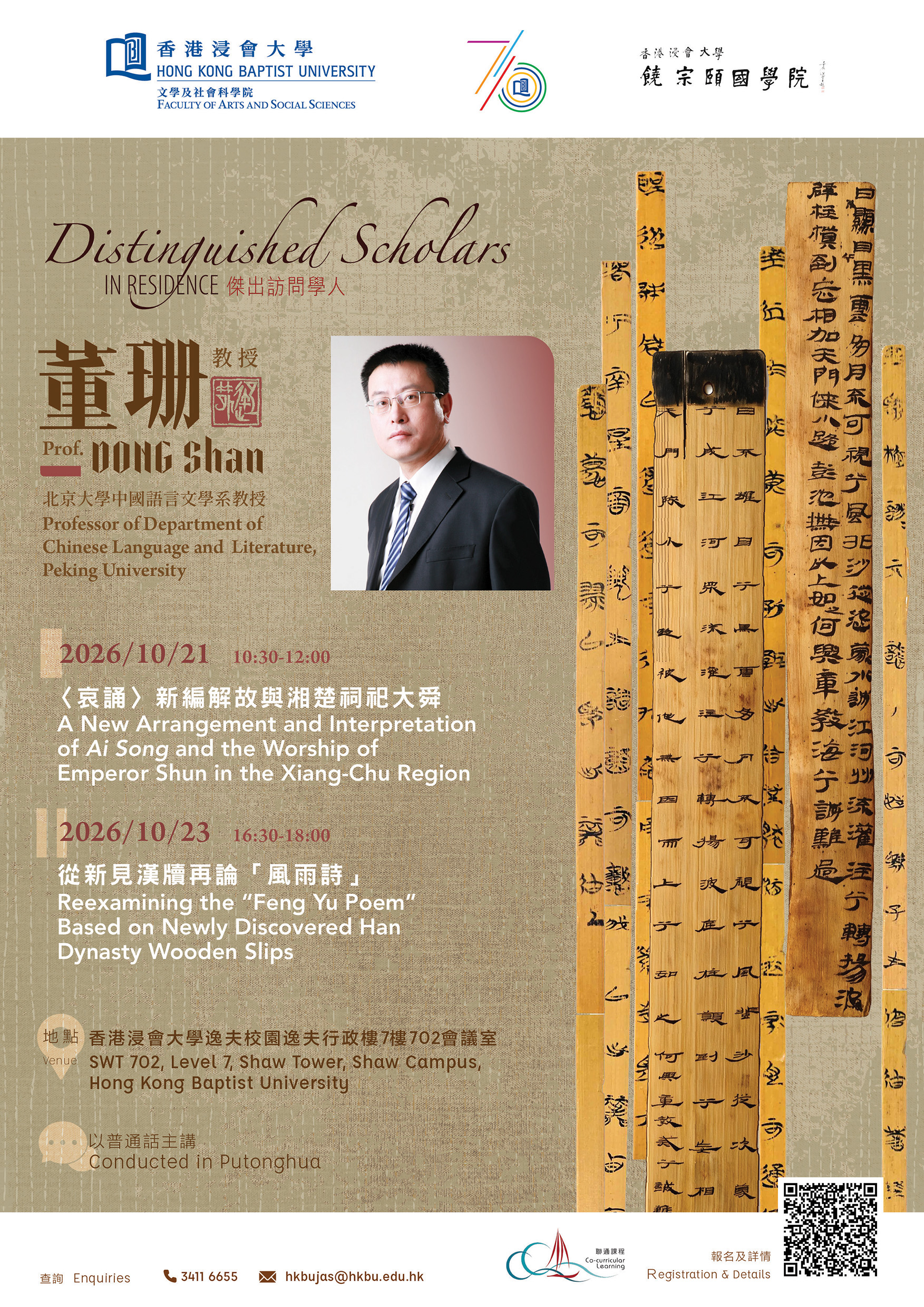
The Academy has established the "Distinguished Scholars in Residence" scheme since 2015, inviting internationally renowned scholars in Chinese Studies and Sinology from around the world to reside on our campus. The scheme offers HKBU faculty and students, together with the local academic community, the opportunity to engage with and learn from world-class masters, enabling students to experience scholarly excellence and research insight at first hand. In 2026, JAS has invited Professor DONG Shan from the Department of Chinese Language and Literature at Peking University to be the Visiting Fellow from 20 to 24 October. Professor Dong will offer two lectures during his stay. Details are as follows:
2026/10/21 | 10:30–12:00
Lecture 1: A New Arrangement and Interpretation of Ai Song and the Worship of Emperor Shun in the Xiang-Chu Region
The recently published Warring States bamboo slips of Ai Song (22 slips) housed at Anhui University belong to the genre of Chu Ci (Songs of Chu) literature. This lecture offers a revised transcription and interpretation of the text based on Chen Qi’s reconstruction of the slip sequence and attempts a comprehensive discussion. The Ai Song can be divided into three major parts: the “Prelude,” the “Ai Song,” and the “Epilogue.” Its content centers on the Chu people’s worship of Emperor Shun in the middle to late Warring States period in the Hunan region. Music and musical instruments serve as the unifying themes and function as multiple metaphors throughout the text. Drawing on historical legends and local Xiang-Chu history, the lecture explores the nature of the worship of Emperor Shun, the context and purpose behind the composition of Ai Song in the Chu slips, and its stylistic relationship with Xiang Jun and Xiang Furen. It also briefly reviews textual and archaeological evidence regarding Emperor Shun’s cult from the Qin and Han periods onward. Only by considering these multiple contexts: ancient legends, historical realities, transmitted texts, and archaeological discoveries, can one better understand the significance of the Warring States Chu slip text Ai Song.
2026/10/23 | 16:30–18:00
Lecture 2: Reexamining the “Feng Yu Poem” Based on Newly Discovered Han Dynasty Wooden Slips
This paper compares two versions of the Feng Yu (“Wind and Rain”) poem preserved on Han dynasty wooden slips, proposing new interpretations of its characters, lexical meanings, syntax, overall meaning, and thematic purport. It argues that the poem is related to the Qin-Han fengshan (imperial sacrifices to Heaven and Earth) rituals and reflects views on fengshan held among the lower and middle strata of Han society. The paper advocates a philological approach that reconstructs meaning based on syntactic structures and emphasizes that variations among different manuscript copies reflect textual transmission layers, thus avoiding forced uniformity or divergence.
Venue: SWT 702, Level 7, Shaw Tower, Shaw Campus, Hong Kong Baptist University
Language: Putonghua
Registration: https://forms.cloud.microsoft/r/7PRj0q0iXr
Speaker Bio:
Professor Dong Shan, Moster of History from the Institute of Ancient Books, Jilin University (1994–1997, specialising in Paleography); Doctor of Literature from the Department of Chinese Language and Literature, Peking University (1999–2002, specialising in Ancient Chinese Philology); Postdoctoral Researcher at the School of Archaeology and Museology, Peking University (2002–2004).
He is currently the Professor of Department of Chinese Language and Literature, and Director of The Teaching and Research Section of Paleography at Peking University. He formerly served as a faculty member in the Neolithic, Shang, and Zhou Archaeology Teaching and Research Section at the School of Archaeology and Museology, Peking University (2004–2022, promoted to Professor in 2016). He was also a Visiting Professor at the Research Institute for Languages and Cultures of Asia and Africa, Tokyo University of Foreign Studies (September 2006–June 2007). His primary research focuses on Chinese paleography and excavated texts, also encompassing bronze artifacts and the history and archaeology of the Pre-Qin, Qin, and Han dynasties. His areas of study include Shang and Zhou oracle bone inscriptions, Shang and Zhou bronze inscriptions, Eastern Zhou, Qin, and Han inscription texts, Pre-Qin and Qin-Han bamboo and silk manuscripts.
————————————————————————————————————
HKBU students: For CCL attendance, please register your student ID onsite, and complete Co‐curricular Learning Evaluation Form online.
Note: A CCL-recognised event must be at least 1 hour long. Please observe the requirements if students wish to update the attendance record.